
Understand UK Payslips
Understanding your UK Payslips ensures you receive the correct pay and catch any tax errors early. Here is a comprehensive guide to breaking down exactly what your monthly or weekly payroll document means.
Why Checking Your Payslips Matters
Your payslip is more than just a summary of your take-home pay. It is a legal document that proves your income, details your tax contributions, and serves as vital evidence when applying for mortgages, loans, or visas. Employers must provide a payslip on or before payday, either electronically or on paper.
- The Core Personal Information
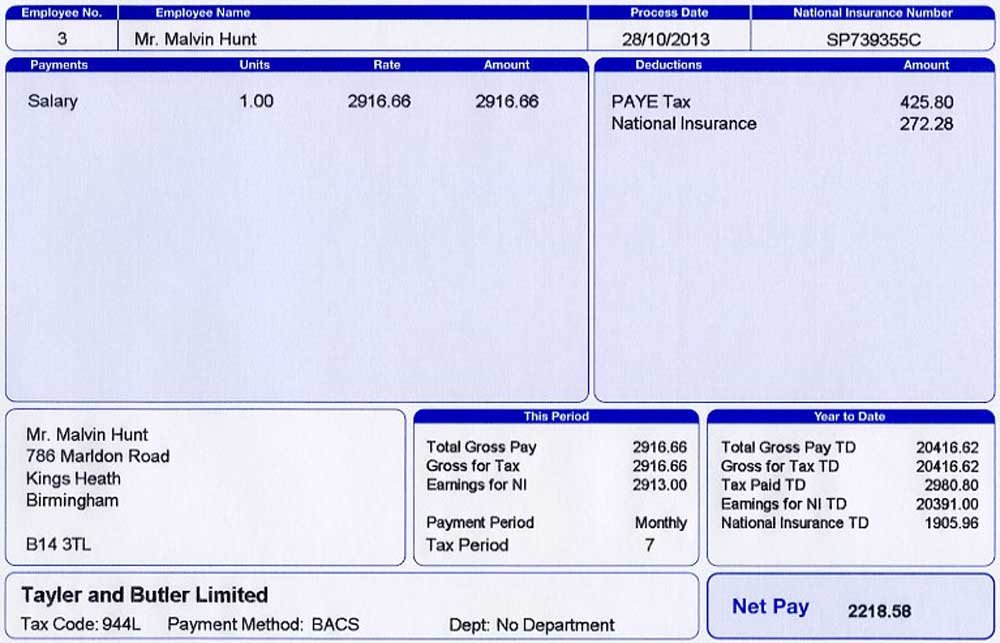
The top section of your Payslips generally contains identifying details for you and your employer.
- Payroll Number: A unique ID your company uses to identify you internally.
- National Insurance (NI) Number: Your unique UK government identifier. It ensures your contributions are recorded against your name.
- Pay Period: The specific week or month you are being paid for.
- Income and Gross Pay
This section lists everything you earned during the pay period before any deductions are made.
- Gross Pay: Your total earnings before tax, National Insurance, or pensions are taken out.
- Basic Pay: Your core salary or hourly wages for your standard hours.
- Overtime / Bonuses: Extra payments listed separately from your standard rate.
- Statutory Pay: Payments like Statutory Sick Pay (SSP) or Statutory Maternity Pay (SMP).
- Demystifying Your Tax Code
Your tax code is the most critical element to check regularly. It tells your employer how much tax-free income you are allowed in a tax year.
- The Standard Code: For most people with one job, the standard code is 1257L. This means you can earn £12,570 per year tax-free (the Personal Allowance).
- BR / DO / D1 Codes: These signal that you are being taxed at a flat rate (Basic Rate or Higher Rate) without a personal allowance. This often happens if you start a second job.
- The ‘W1’ or ‘M1’ Suffix: These indicate emergency tax codes. They mean your tax is calculated only on that single pay period, rather than cumulatively across the whole financial year.
- Statutory Deductions
These are mandatory deductions required by UK law.
- PAYE (Pay As You Earn): The income tax collected on behalf of HM Revenue and Customs (HMRC).
- National Insurance (NI): Contributions that qualify you for the State Pension and certain benefits. Most employees see “Class 1” deductions here.
- Student Loan: Deductions taken if you earn over the threshold for your specific loan plan (e.g., Plan 1, Plan 2, or Plan 5).
- Voluntary and Workplace Deductions
These deductions depend on your job benefits and personal choices.
- Workplace Pension: Your contribution to your retirement savings, usually calculated as a percentage of your qualifying earnings.
- Cycle to Work / Healthcare: Salary sacrifice schemes where you pay for benefits out of your gross salary, reducing your overall tax burden.
- Union Fees: Direct payments to professional bodies or trade unions.
- The Bottom Line: Net Pay
- Net Pay: The most important figure for your bank account. This is your actual “take-home pay” after every single deduction has been subtracted from your gross pay.
Year-to-Date (YTD) Summary
Most payslips feature a “YTD” column. This displays the cumulative totals of your gross pay, tax, and National Insurance paid since the start of the current UK tax year (which always begins on 6th April). It is incredibly useful for tracking whether you are on course to cross tax brackets.
England: Bath, Birmingham, Bradford, Brighton, Bristol, Cambridge, Canterbury, Carlisle, Chelmsford, Chester, Chichester, Colchester, Coventry, Derby, Doncaster, Durham, Ely, Exeter, Gloucester, Hereford, Hove, Kingston upon Hull, Lancaster, Leeds, Leicester, Lichfield, Lincoln, Liverpool, London, Manchester, Milton Keynes, Newcastle upon Tyne, Norwich, Nottingham, Oxford, Peterborough, Plymouth, Portsmouth, Preston, Ripon, Salford, Salisbury, Sheffield, Southampton, Southend-on-Sea, St Albans, Stoke-on-Trent, Sunderland, Truro, Wakefield, Wells, Westminster, Winchester, Wolverhampton, Worcester, York. Scotland: Aberdeen, Dundee, Dunfermline, Edinburgh, Glasgow, Inverness, Perth, Stirling. Wales: Bangor, Cardiff, Newport, St Asaph, St Davids, Swansea, Wrexham. Northern: Ireland, Armagh, Bangor, Belfast, Lisburn, Londonderry (Derry), Newry